Eliseo Art Silva
A Manila-born artist who painted four thousand years of Filipino American history onto a Hollywood wall at age 22, and has spent the three decades since making work that insists immigrant lives, labor struggles, and matriarchal courage deserve to be seen at the scale of a city.
Shop Eliseo Art SilvaEliseo Art Silva is a Filipino artist who can be celebrated both for his craft and conscience. He completed one of his most important works at the mere age of 22, a mural in Historic Filipinotown that tells four thousand years of Filipino American history, including the parts that power tried to erase. Three decades later, he's still at it, now splitting his time between Los Angeles and an art school he's building in Manila.
The Founders
Eliseo Art Silva
Visual Artist & Muralist
Fast Facts
He Was 22 When He Painted Filipino History Onto a Hollywood Wall.
Eliseo Art Silva was born in Manila in 1972 — the same year Ferdinand Marcos declared Martial Law. He grew up making art with the urgency of someone who understood, from childhood, that images carry power. At the Philippine High School for the Arts, he graduated with full honors and a Gold Medal as the most outstanding visual artist in his class. At 17, he migrated to the United States.
The formal training that followed was exceptional. A BFA from Otis College of Art and Design in 1995 — where he was a Getty Museum Internship Arts Fellow and studied under Judy Baca, a future National Medal of the Arts recipient. An MFA from the Maryland Institute College of Art in 2003, mentored by Grace Hartigan and Dominique Nahas, supported by a Joan Mitchell Foundation Grant and a full scholarship to the Skowhegan School of Painting and Sculpture. He was being shaped by the best. But his most defining work came before any of it.
At 22, Silva painted Gintong Kasaysayan, Gintong Pamana — “A Glorious History, A Golden Legacy” — in Historic Filipinotown, Los Angeles. The mural spans four thousand years of Filipino and Filipino American history and was the first public work to honor Larry Itliong and the approximately 2,000 Filipino American farmworkers who sparked the 1965 Delano Grape Strike. The Smithsonian Institution described it as “bold and daring.” It remains a landmark of the neighborhood and of Filipino American public art.
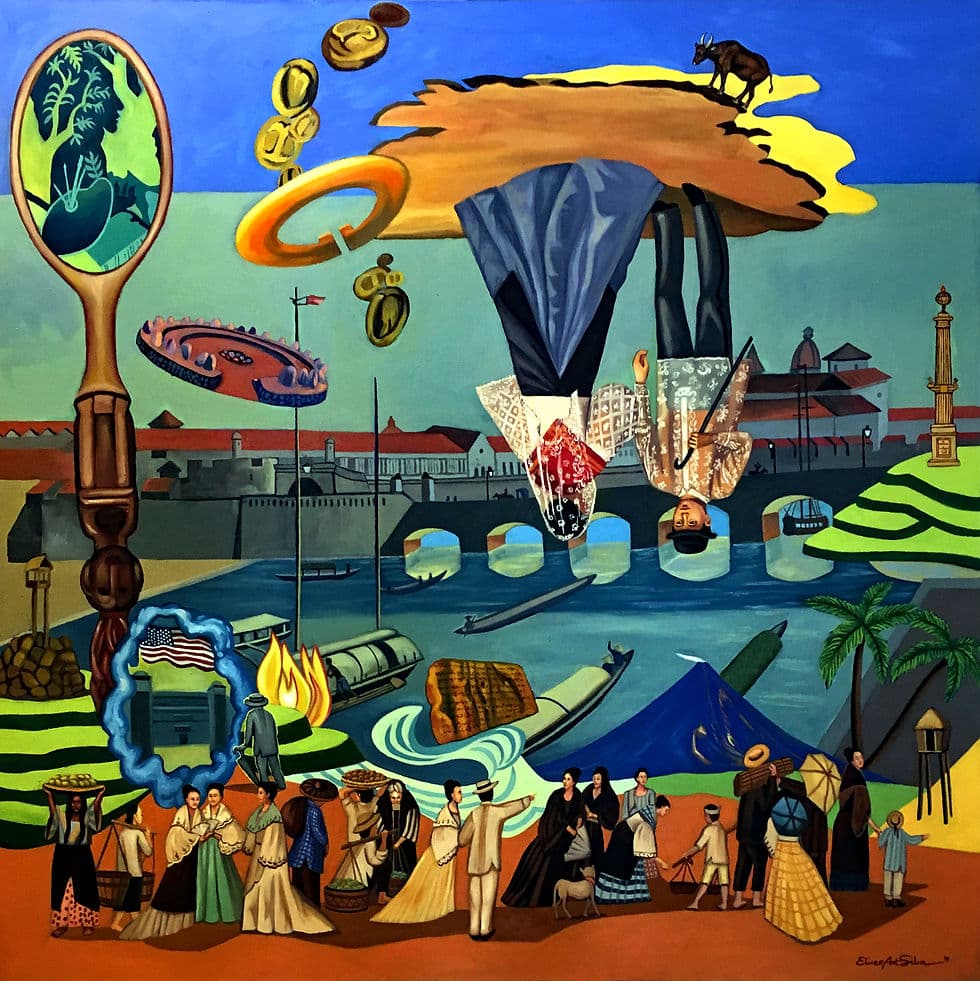
The decades that followed produced an expansive body of work. Canvas paintings that center matriarchal immigrant strength: migrant mothers holding palaspas, domestic workers freed after a lifetime of forced labor, the word welga (strike) woven into images of solidarity across Filipino American and Mexican American communities. Community murals created with youth participants across South Central and Mid City Los Angeles. Two books on Filipino American history published by Arcadia. Exhibitions at the Smithsonian National Museum of American Art, LACMA, the Honolulu Academy of Art, the Cultural Center of the Philippines, and institutions across Mexico, India, and Canada.
In 2021, Silva began constructing an art studio and art school in the Philippines, splitting his time between Los Angeles and Manila.
Why We Featured Them
What Makes Eliseo Art Silva Different
01
The Mural That Changed Filipino American History
At 22, before finishing his BFA, Silva painted Gintong Kasaysayan, Gintong Pamana in Historic Filipinotown, the first public work to honor Larry Itliong and the Filipino Americans who sparked the 1965 Delano Grape Strike. The Smithsonian Institution called it “bold and daring.” It still stands today.
02
Institutional Rigor, Community Purpose
BFA from Otis College of Art and Design (Getty Museum Arts Fellow, mentored by Judy Baca). MFA from Maryland Institute College of Art (Joan Mitchell Foundation Grant, Skowhegan residency). Silva built his practice with the highest training available and turned every tool of it toward Filipino American history and immigrant lives.
03
A Master of Many Mediums
From monumental murals to oil paintings to youth community projects to published history books, Silva’s practice spans every form the Filipino American story needs.
Ready to own
a piece?
Each collection is limited — when it's gone, it's gone.